The government’s youth inactivity adviser swore at Disability News Service’s editor after being challenged about his failure to discuss the safeguarding risks involved in forcing tens of thousands of young disabled people into employment.
A series of speeches by former New Labour minister Alan Milburn were enthusiastically welcomed at this week’s Labour conference in Liverpool by lobbyists and party members who crowded into fringe venues to hear him speak about his review for the government on young people not in education, employment or training (NEETs).
He spoke repeatedly of the need for “fundamental transformation” of the social security and employment support systems and said his final report – due in the next few weeks – would “feel very much like a manifesto for change”.
He insisted that young people were “the most resilient generation there has ever been”, despite substantial evidence of a mental health crisis among younger people.
It seems likely that his recommendations will suggest that only a very small proportion of young disabled people should not be pushed towards education, work or training, telling one fringe event: “Work is purposeful for young people and every young person has something to give.
“Work beats welfare. Not every single time – there’s a group of young people in society who are never going to be able to work because of the severity and complexity of their disabilities.
“Our job, the state’s job, is to provide them with a secure future and a secure income for the future to compensate for the fact that they can’t work.
“Every other young person who can work should work.”
He added: “Unfortunately, what the state does all too often is ask the wrong question, which is what can’t you do, rather than what can you do, and how can we enable you and support you and help you to realise those opportunities.
“And that particularly applies to the generation of young people who are suffering from anxiety, depression, ADHD and autism, which are the principle drivers now behind the sort of crisis that we have.”
The speeches heard by Disability News Service (DNS) mirrored the findings of Milburn’s interim report in May by failing to discuss or analyse the safeguarding risks of his “manifesto”.
But when DNS editor John Pring approached him after one of the fringe events and asked about these safeguarding risks, he sighed and said he did not want to discuss that issue and did not have time to answer any questions because he was leaving for another appointment.
Pring suggested they could talk as he walked alongside him, but Milburn turned his back and refused to engage with the questions.
Pring attempted to explain why the issue was so important, explaining that the last time a Labour government tried to force hundreds of thousands of out-of-work disabled people into employment – in 2008, through the work capability assessment – it led to 600 suicides in three years, mostly under the subsequent coalition government.
But Milburn refused to engage or respond and kept his back turned to him – while his assistant said repeatedly that he did not want to do an interview – as Pring tried to ask him about the risks of his suggested strategy, which is expected to be published later this month.
Milburn eventually stopped, clearly angry, and said: “Hey, hey, HEY! I said no! Just stop! I said no,” and told Pring to go through “the correct channels” if he wanted an interview.
When Pring said it was “perfectly legitimate” for a reporter to challenge him about such an influential report – which carries significant safeguarding risks – Milburn said: “It’s perfectly legitimate to fucking doorstep me, is it?”
He then added: “Fucking wanker.”
Milburn then told him again to “go through the right channels” and nudged him with his arm.
When Pring objected, he said: “Oh, don’t be so sensitive…”
Milburn then walked away with his assistant.
Earlier that day, the minister for social security and disability, Sir Stephen Timms, had told DNS that he believed Milburn would “be aware” of the many deaths linked to the Department for Work and Pensions.
Sir Stephen said he had not discussed safeguarding with Milburn, but he added: “I do think it’s important.”
There is no mention in Milburn’s interim report of the years of evidence linking DWP safeguarding failures and the actions of civil servants and ministers with the deaths of claimants.
Many of these claimants, such as Michael O’Sullivan, took their own lives due to DWP’s attempts to find them fit for work and push them back into jobs.
Roy Curtis was only 25 when DWP began its efforts to force him towards employment support and work; two years later, he took his own life at his flat in Milton Keynes.
But despite hundreds of secret internal reviews carried out by DWP into deaths linked to its actions and failings, there is nothing in the 217 pages of Milburn’s interim report about the risks involved in trusting what is widely seen as a failing government department with the safety of young disabled people, particularly those with significant levels of mental distress, and forcing them into employment support and the workplace.
Work and pensions secretary Pat McFadden told the conference on the same day as Milburn’s confrontation with DNS that, from next April, the government would make its jobs guarantee available to young disabled people after three months.
This will offer them paid work for six months at living wage rates – on a voluntary basis – three months after undergoing their work capability assessment, along with mentoring and support.
The government will cover 100 per cent of the wage costs for up to 25 hours a week for six months.
The government launched its jobs guarantee scheme earlier this year for long-term unemployed young people aged 18-24 who have been claiming universal credit for 18 months.
McFadden said the government wanted “a new system focussed on opportunity” that moved from “asking what are you entitled to, to asking, ‘how do we change your life?’”.
One disabled researcher, Stef Benstead, described the new policy as “interesting” but she raised a key concern.
She said, in a series of posts on X: “For people with static disabilities and capacity to work, it could be transformative – if coupled with timely Access to Work.
“But for people assessed as too ill to work, what does govt expect will actually happen?
“This feels like part of politicians’ ongoing failure to understand the existence and nature of ‘chronic illness’.
“Chronic illness is chronic – it lasts a long time. It’s illness – it makes you unwell. It limits your capacity for activity/work. For a long time.
“It’s that simple.”
She added: “Politicians seem determined to believe that activity-limiting illness that lasts for years ‘isn’t a thing’.
“They’re insistent that we can all work, actually. They refuse to believe that maybe a whole load of people are too sick to work, and stay too sick to work for a long time.”
Other disabled activists were also critical.
Journalist and author Rachel Charlton-Dailey said on X: “The government knows these young people are too sick and disabled to work, they want to force them into low-paying jobs that will make them even worse.”
The grassroots, user-led mental health group Recovery in the Bin added: “It’s six months cheap labour, no job.”
Meanwhile, the prime minister, Andy Burnham, said in his speech to conference on Tuesday – repeating previous commitments – that he wanted to reduce the “welfare bill” through improved support and more people in work rather than “through crude cuts”.
He said he awaited Milburn’s final report but warned that there would need to be a “fundamental rethink of the welfare system” to pay for changes to education, support, work experience, apprenticeships and mental health support for young people.
And he said the government would “require young people to take up the help presented to them”, which he said was “a different approach to welfare” and was “based on a philosophy of social security”.
*The following organisations are among those that could be able to offer support if you have been affected by the issues raised in this article: Mind, Rethink, Samaritans, and SOS Silence of Suicide
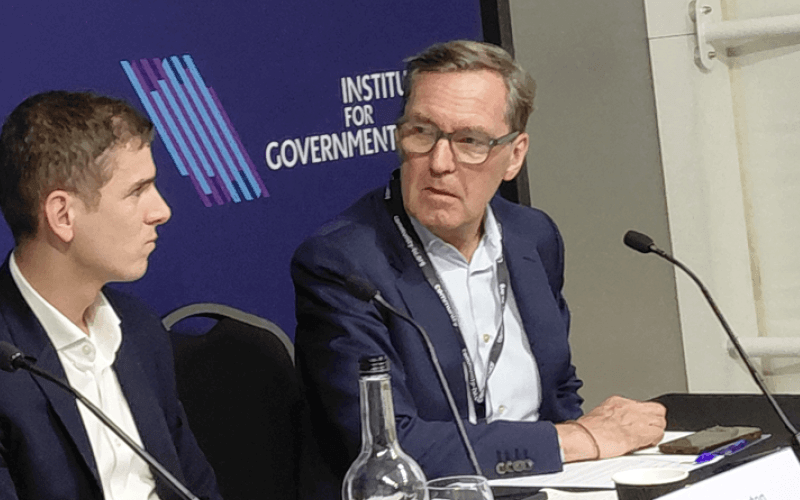
Picture: Alan Milburn (right) on one of the panels at the Labour conference
 The Times ignores efforts to draw its attention to years of DWP deaths as it launches its own ‘welfare inquiry’
 Ministers’ decision to slash accessible housing targets was ‘unprincipled’, but Timms says they were right
 Tories discriminate against disabled editor by blocking DNS from receiving key information at conference